


Onset of immunity
The onset of immunity is 2 weeks after the 2nd vaccination dose, with the 2nd vaccination administered 4 weeks after the 1st vaccination.
- 32 ponies: 16 vaccinated, 16 controls
- Vaccinated group: vaccinated with Strangvac 2ml IM
- Control group: vaccinated with placebo control vaccine (containing adjuvant only)
- Challenge with S. equi strain Se4047, 5×10⁻⁷ cfu into each nostril

- 100% of control ponies (n = 16) developed strangles
- Reduction of signs in 31% of Strangvac ponies (no pyrexia in 5/16, P = 0.04)
- Reduced severity and slower onset of acute disease
- Fewer lymph node abscesses

11 of 16 vaccinated ponies became pyretic, but the onset was delayed giving more time to vets to isolate affected horses before shedding of S. equi began.

Duration of immunity
After the primary course of 2 vaccinations, the duration of immunity has been shown to last for 2 months.
- 16 ponies: 12 vaccinated, 4 controls
- Vaccinated group: vaccinated with Strangvac 2ml IM
- Control group: vaccinated with placebo control vaccine (containing adjuvant only)
- Challenge with S. equi strain Se4047, 5×10⁻⁷ cfu into each nostril

- 100% of placebo ponies (n = 4) developed strangles
- Reduction of signs in 58% of Strangvac ponies (no pyrexia in 7/12, P = 0.09)
- Reduced severity and onset of acute disease including fewer lymph node abscesses
11 of 16 vaccinated ponies became pyretic, but the onset was delayed giving more time to vets to isolate affected horses before shedding of S. equi began.

Additional efficacy data
IdeE activity is still neutralized by sera from ponies 6 months after 2nd vaccination with Strangvac. (Righetti et al., 2021, Equine Veterinary Journal).
- 43 ponies: 28 vaccinated, 15 controls
- Vaccinated group: vaccinated with Strangvac 2ml IM 3 times, with 3rd dose given at 3, 6 or 12 months after 2nd vaccination.
- Control group: vaccinated with placebo control vaccine (containing adjuvant only)
- Serum samples were used to measure anti-IdeE responses by conventional iELISA and the neutralisation of the cleavage of antibodies by IdeE using a western blot-based assay.
IdeE activity is still neutralized by sera from ponies 6 months after 2nd vaccination (Righetti et al., new paper).
After the 2nd dose an immune memory is generated that lasts for 12 months. Revaccination within this time frame generates a similar antibody response in blood and nasal secretions as that seen after the 2nd vaccination.
- 12 ponies, all vaccinated
- Vaccinated group: vaccinated with Strangvac 2ml IM
- Antibody response to all 3 vaccine components measured in serum and nasal wash samples

Vaccinated horses have an immune memory for 12 months after the 2nd dose, which can be activated by another dose of Strangvac.
The graphs below show levels of different types of antibodies in serum and nasal wash samples:
- Strangvac induced antibody responses in blood serum and nasal secretions
- Responses remained elevated post-vaccination and were boosted after 3, 6 or 12 months


- 31 ponies: 16 vaccinated, 15 controls
- Vaccinated group: vaccinated with Strangvac 2ml IM
- Control group: vaccinated with placebo control vaccine (containing adjuvant only)
- Challenge with S. equi strain Se4047, 5×10⁻⁷ cfu into each nostril.
- 100% of control ponies (n = 15) developed strangles
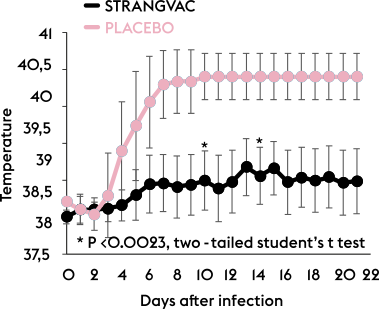
- Reduction of signs in 94% of Strangvac ponies (no pyrexia in 15/16, P < 0.0001)
- No lymph node abscesses in 94% of Strangvac ponies, P = 0.00001

This graph shows body temperature.
Only one vaccinated pony became pyretic.

This graph shows the number of lymph node abscesses.
Only one Strangvac-vaccinated pony developed an abscess.
Safety
Strangvac is tested safe for use in horses from the age of 5 months.
Strangvac does NOT contain live bacteria, and therefore cannot cause strangles as has been reported with the use of live vaccines (Livengood et al., 2016, Vaccine; Cursons et al., 2015, Vaccine; Newton et al., 2005, Vet Rec; Kelly et al., 2006, J Clin Microbiol, Harris et al., 2015, Genome Research; Mitchell et al., 2021, Microbial Genomics)*4
Adverse effect
The following adverse reactions can be seen after vaccination with Strangvac:
- Transient increase in body temperature of up to 2.6°C for one to five days (very common)
- Transient local tissue reactions at the injection site, characterised by heat, pain and swelling (approximately 5 cm diameter) (very common)
- Loss of appetite and demeanour changes for one day (common).
- Ocular discharge which may be mucopurulent and present from both eyes (very common)
- Anaphylactic-like reactions occur in very rare cases.
For a full description of adverse reaction please consult the SPC.

Leave A Comment