


Horse owners
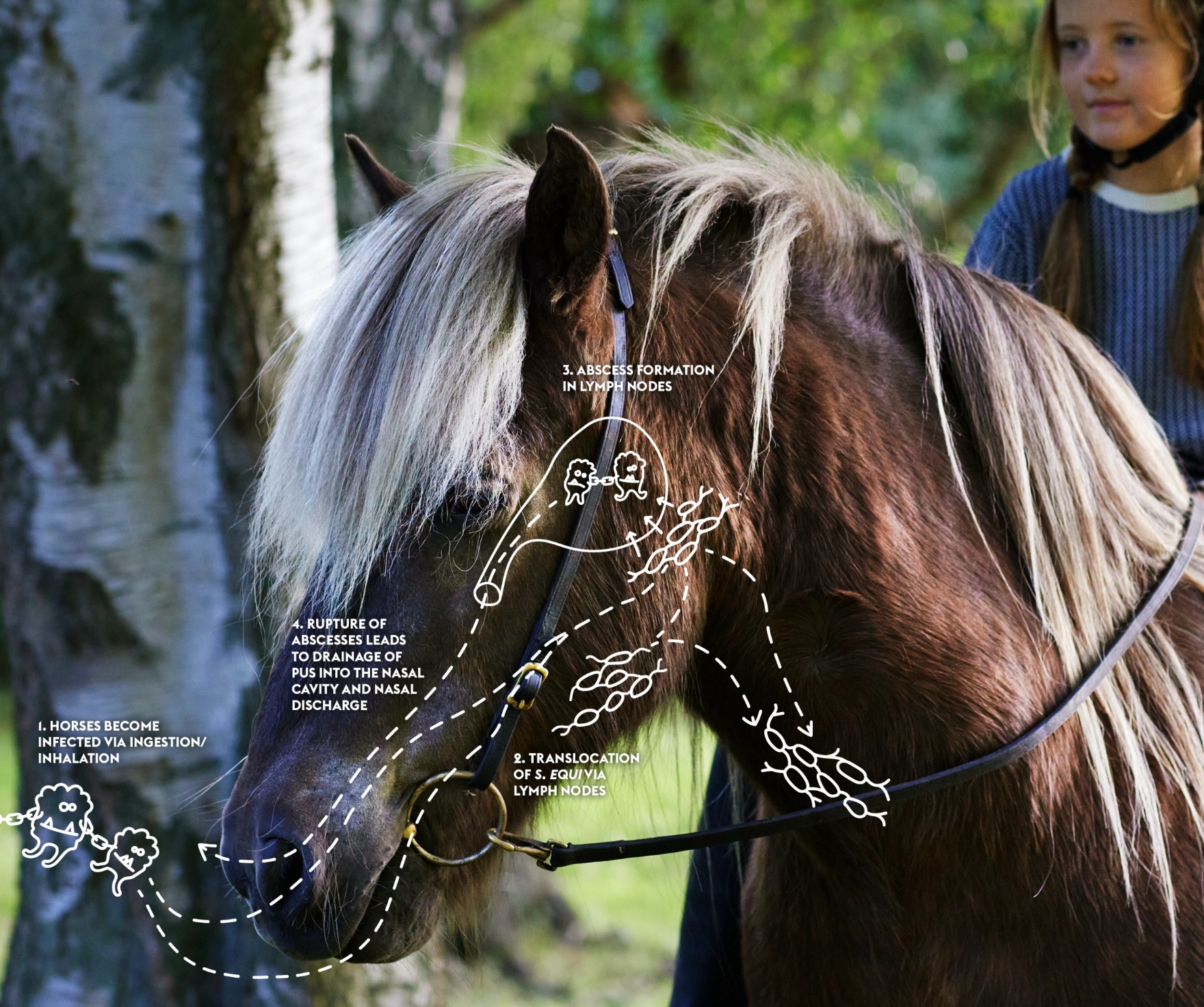
Strangles is a highly contagious disease in horses worldwide which is caused by the bacterium Streptococcus equi subspecies equi and is characterized by inflammation of the upper airways and abscessation of lymph nodes of the head and neck.
Read more about how we can work together to stop strangles!
Horse owners
Strangles is a highly contagious disease in horses worldwide which is caused by the bacterium Streptococcus equi subspecies equi and is characterized by inflammation of the upper airways and abscessation of lymph nodes of the head and neck.
Read more about how we stop Strangles together!
Clinical signs of Strangles
- Fever (body temperature >38.5 oC)
- Nasal discharge
- Soft moist cough
- Depression
- Inappetence
- Abscesses in the lymph nodes of the head and neck (and other body sites in rare cases)
- Up to 100% morbidity and 10% mortality (if high infectious dose)
Pathogenesis: strep. Equi infection pathway
Watch the video to see how horses become infected with Strep. equi and how the bacterium behaves once inside the horse’s body.
Carriers: the secret of strep. Equi for persisting in populations
- All horses have two guttural pouches, which are extensions of the middle ear
- Streptococcus equi enters the guttural pouch during disease and can persist here in around 10% of recovered ‘carrier’ horses.
- Carriers look healthy, but can spread strangles to other horses

Given the impact a strangles outbreak can have from a welfare and economical perspective, preventing the disease is a much more attractive scenario than having to deal with an outbreak. Biosecurity and vaccination are the two important aspects of prevention and they go hand-in-hand
Watch the video below to learn about preventative measures for controlling strangles:
What are the most important biosecurity measures?
- Quarantine new arrivals to a yard for a minimum of three weeks so that they have no direct with other horses, nor indirect contact via equipment used for other horses.
- Test horses using the Strangles blood test and guttural pouch endoscopy ideally before arrival or whilst in quarantine to identify horses exposed to S. equi.
- Do not allow your horse to share drinking water and avoid direct contact with other horses whilst attending equine events.
- Regularly clean and disinfect all food and water containers, clothing, stabling and equipment at your yard. • Clean and disinfect horseboxes/trailers before and after collecting any new horses.
- Wash hands between handling different horses.
What are the benefits of vaccination?
Vaccination against strangles can:
- Reduce the severity of clinical symptoms.
- Reduce the number of abscesses and spread of the disease.
- Improve protection at individual horse level as well as on a yard level.
- Reduce the risk of horses contracting strangles whilst travelling to other premises or attending equine events.
Vaccination aims at maximizing herd immunity, which is achieved when a high proportion of a population is vaccinated. As a result it becomes difficult for a contagious agent to spread because there are not many animals left who can become infected and transmit the disease.
What is diva and why is it important?
DIVA is short for: Differentiate Infected from Vaccinated Animals. Horses vaccinated with a DIVA vaccine can attend events and sales or move yards normally without triggering positive tests, unless they have been exposed to S. equi. Recently a new intramuscular strangles vaccines has become available that does not contain live or killed S. equi cells and instead targets the equine immune response to 8 important proteins to give the best protection. These proteins are different from the once leading to a positive response in diagnostic tests tests.
Faqs about vaccination against strangles
– Which horses are most at risk of strangles?
Young and old horses are at highest risk of severe disease if they become infected with S. equi. Vaccination protects these susceptible horses from potential introductions of S. equi. Vaccination is also highly recommended for: horses before competition, sales or possible exposure events and for horses in an area with known outbreaks of strangles. Vaccinating all horses on the farm raises herd immunity, and decreases the risk of spread of the disease.
– Can I vaccinate my horse if my yard has an index case of strangles?
There are some guidelines with respect to vaccination in an outbreak or high-risk situation:
- Horses with clinical signs and those in contact should not be vaccinated
- Vaccinated horses that have not been in contact with cases:
- Last dose >2 months: booster doses will maximise immunity
- Last dose <2 months: no booster required
- Unvaccinated horses: start primary course: partial protection from 2 weeks after 2nd dos
– Will I still need to quarantine my vaccinated horse if I move yards?
This will depend on the biosecurity policy of the yard and whether the horse has also been vaccinated against other equine infectious diseases klike influenza and equine herpes disease. With respect to strangles however, if the horse has been vaccinated, there is no reason for quarantine anymore.
– Will my horse test positive for strangles after being vaccinated?
This will depend on the type of vaccine being used. If a vaccine with DIVA capability has been used, then the horse will not test positive, unless it has been infected with S. equi previously.
– Will I still be able to ride/compete my horse immediately after vaccination?
It is generally recommended not to exercise horses in the 2 to 3 days following vaccination. This depends on whether the horse shows a rise in body temperature as a reaction to vaccination or not. Temporary fever after vaccination is not uncommon as this is part of the immune system activation.

What to do when a horse has strangles in your yard
- Take immediate action!
- Stop all horses moving on or off the yard.
- Use isolation as a precaution for all horses while you speak to your vet and arrange for testing.
- Use the ‘traffic light’ system to segregate horses into groups and minimise the risk to other horses on the yard and the surrounding area.
- Spot the clinical signs of strangles and take temperature of each horse at least twice a day.
- After outbreak, disinfect stables, paddocks and equipment to make them free of infection.
- Look for carriers to prevent persistent infection and new outbreaks.
Hould affected horses receive medical treatment?
Treatment of acute cases
A proportion of infected horses will recover without treatment, but the recovery period is relatively long and usually takes 3 to 6 weeks if no complications occur.
Early treatment of exposed horses with antibiotics (penicillin) may prevent abscess formation.
However:
- Lymph node abscesses quickly become so large that antibiotics cannot penetrate to sufficient levels
- Treatment may be required for several weeks and the infection could still flare up again when treatment stops.
- Antibiotic resistance is emerging (12.5% of UK isolates).
- Antibiotic treatment may interfere with natural immunity.
Severe cases require emergency treatment with antibiotics, corticosteroids and/or surgical intervention (tracheostomy).
Treatment of carriers
- Physical removal of chondroids
- Procaine benzylpenicillin administered into guttural pouches
- Systemic antibiotics for 2 weeks
- Repeat endoscopy and lavage to confirm infection free status

Strangles is one of the most frequently diagnosed infectious disease of horses (typically between 5 and 100 times more outbreaks than of equine influenza)
Some large outbreaks can affect hundreds of horses and have a high economical and welfare impact.
Only Iceland remains free of strangles
The horse and strep. Equi are both globetrotters
Horses travel around the world to attend equine events or sales, which also bears the risk of transmission of infectious diseases worldwide. Recently, a global platform for genomic surveillance of S. equi was created and 670 isolates from 19 countries were examined. This unique project highlighted numerous examples of the transmission of S. equi around the world and the importance of biosecurity, diagnostic testing and vaccination for the prevention of disease transmission. The study identified 6 broad types of S. equi (BAPS-types), with emergence and dominance of BAPS2 in Europe4.

Argentina, Outbreak 1
UK, Outbreak 152
UAE, Outbreak 2
The same variant of S. equi was recovered from polo ponies in Argentina, the United Arab Emirates and the UK, highlighting one example of the international transmission of S. equi.
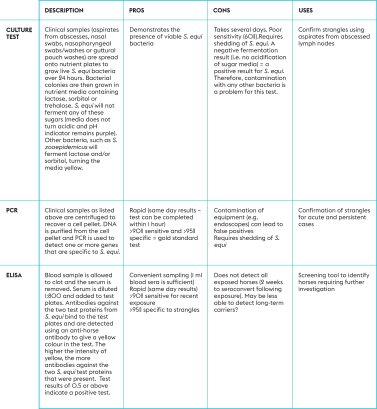
Culture test, PCR and ELISA
Additional information about strangles disease, outbreak management and disease control, can be found on:
What do you need to know about strangles

Clinical signs of Strangles
- Clinical signs of strangles
- Fever (body temperature >38.5 oC)
- Nasal discharge
- Soft moist cough
- Depression
- Inappetence
- Abscesses in the lymph nodes of the head and neck (and other body sites in rare cases)
- Up to 100% morbidity and 10% mortality (if high infectious dose)
Pathogenesis: The path followed by s. equi
Watch the video to see how horses become infected with Strep. equi and how the bacterium behaves once inside the horse’s body.
Carriers: the secret of long-term persistance Of s. Equi in horse populations
- All horses have two guttural pouches, which are extensions of the middle ear
- Streptococcus equi enters the guttural pouch during disease and can persist here in around 10% of recovered ‘carrier’ horses.
- Carriers look healthy, but can spread strangles to other horses
How to
prevent strangles?
Given the impact a strangles outbreak can have from a welfare and economical perspective, preventing the disease is a much more attractive scenario than having to deal with an outbreak. Biosecurity and vaccination are the two important aspects of prevention and they go hand-in-hand.
Watch the video below to learn about preventative measures for controlling strangles:
What are the most important biosecurity measures?
- Quarantine new arrivals to a yard for a minimum of three weeks so that they have no direct contact with other horses, nor indirect contact via equipment used for other horses.
- Test horses using the strangles blood test and examine positive horses by guttural pouch endoscopy ideally before arrival or whilst in quarantine to identify horses exposed to S. equi.
- Do not allow your horse to share drinking water and avoid direct contact with other horses whilst attending equine events.
- Regularly clean and disinfect all food and water containers, clothing, stabling and equipment at your yard.
- Clean and disinfect horseboxes/trailers before and after collecting any new horses.
- Wash hands between handling different horses.
What are the benefits of vaccination against equine infectious diseases?
Vaccination against equine infectious diseases can:
- Reduce the severity of clinical signs.
- Reduce the spread of disease.
- Improve protection at an individual horse level and a yard level.
- Reduce the risk of horses contracting infectious diseases whilst travelling to other premises or attending equine events.
Vaccination aims to maximize herd immunity, which is achieved when a high proportion of a population is vaccinated. As a result it becomes difficult for a contagious agent to spread because there are not many animals left who can become infected and transmit the disease.
What is DIVA and why is it important?
DIVA is short for: Differentiate Infected from Vaccinated Animals. Horses vaccinated with a DIVA vaccine can attend events and sales or move yards normally without triggering positive tests, unless they have been exposed to S. equi. Recently a new intramuscular strangles vaccine has become available that does not contain live or killed S. equi cells and instead targets the equine immune response to 8 important proteins to give the best protection. These proteins are different from those used in the strangles blood test, so a vaccinated horse does not test positive.
Faqs about vaccination against strangles
– Which horses are most at risk of strangles?
Young and old horses are at highest risk of severe disease if they become infected with S. equi. Vaccination protects these susceptible horses from potential introductions of S. equi. Vaccination is also highly recommended for: horses before competition, sales or possible exposure events and for horses in an area with known outbreaks of strangles. Vaccinating all horses on the farm raises herd immunity, and decreases the risk of spread of the disease.
– Can I vaccinate my horse if my yard has an index case of strangles?
There are some guidelines with respect to vaccination in an outbreak or high-risk situation:
- Horses with clinical signs and those in contact should not be vaccinated.
- Vaccinated horses that have not been in contact with cases:
- Last dose >2 months: booster doses will maximise immunity.
- Last dose <2 months: no booster required.
- Unvaccinated horses: start primary course: partial protection from 2 weeks after the 2nd dose.
– Will I still need to quarantine my vaccinated horse if I move yards?
This will depend on the biosecurity policy of the yard and whether the horse has also been vaccinated against other equine infectious diseases klike influenza and equine herpes disease. With respect to strangles however, if the horse has been vaccinated, there is no reason for quarantine anymore.
– Will my horse test positive for strangles after being vaccinated?
This will depend on the type of vaccine being used. If a vaccine with DIVA capability has been used, then the horse will not test positive, unless it has been recently exposed to or infected with S. equi.
– Will I still be able to ride/compete my horse immediately after vaccination?
It is generally recommended not to exercise horses in the 2 to 3 days following vaccination. This depends on whether the horse shows a rise in body temperature as a reaction to vaccination or not. Temporary fever after vaccination is not uncommon as this is part of the process of activating the horse’s immune system.
How to deal with an outbreak situation and how to treat strangles?
What to do when a horse has strangles in your yard
- Take immediate action!
- Stop all horses moving on or off the yard.
- Use isolation as a precaution for all horses while you speak to your vet and arrange for testing.
- Use the ‘traffic light’ system to segregate horses into groups and minimise the risk to other horses on the yard and the surrounding area.
- Spot the clinical signs of strangles and take the temperature of each horse at least twice a day. Isolate horses with a fever or other signs of strangles in a ‘red’ group to minimise the exposure of other horses to S. equi.
- After the outbreak, disinfect stables and equipment to make them free of infection. S. equi will survive for up to a week on most surfaces and for up to six weeks in water.
- Ask your vet to look for carriers to prevent persistent infection and reccurent outbreaks.
Should affected horses receive medical treatment?
Treatment of acute cases
The vast majority of infected horses will recover without treatment, but the recovery period is relatively long and usually takes 3 to 6 weeks if no complications occur. Early treatment of exposed horses with antibiotics (penicillin) may prevent abscess formation.
However:
- Lymph node abscesses quickly become so large that antibiotics cannot penetrate to sufficient levels.
- Treatment may be required for several weeks and the infection could still flare up again when treatment stops.
- Antibiotic resistance is emerging (12.5% of UK isolates).
- Antibiotic treatment may interfere with natural immunity.
Severe cases require emergency treatment with antibiotics, corticosteroids and/or surgical intervention (tracheostomy).
Treatment of carriers
- Physical removal of chondroids
- Procaine benzylpenicillin administered into guttural pouches
- Systemic antibiotics for 2 weeks
- Repeat endoscopy and lavage to confirm infection free status
Worldwide prevalence of strangles
Strangles is one of the most frequently diagnosed infectious disease of horses (typically between 5 and 100 times more outbreaks than of equine influenza).
- Approximately 300 outbreaks per year are reported in the UK.
https://app.jshiny.com/jdata/ses/sesview/ - Approximately 76 outbreaks per year are reported in Sweden.
https://www.sva.se/djurhalsa/smittlage/karta-over-kvarka/
Some large outbreaks can affect hundreds of horses and have a high economical and welfare impact.
Only Iceland remains free of strangles.
The horse and strep. Equi are both globetrotters
Horses travel around the world to attend equine events or sales, which also increases the risk of transmission of infectious diseases worldwide. Recently, a global platform for genomic surveillance of S. equi was created and 670 isolates from 19 countries were examined. This unique project highlighted numerous examples of the transmission of S. equi around the world and the importance of biosecurity, diagnostic testing and vaccination for the prevention of disease transmission. The study identified 6 broad types of S. equi (BAPS-types), with emergence and dominance of BAPS2 in Europe 4.
UK, Outbreak 152
UAE, Outbreak 2
Argentina, Outbreak 1
The same variant of S. equi was recovered from polo ponies in Argentina, the United Arab Emirates and the UK, highlighting one example of the international transmission of S. equi.
How to confirm strangles by diagnostic testing?
Culture test, PCR and ELISA
| DESCRIPTION | PROS | CONS | USES | |
|---|---|---|---|---|
| CULTURE TEST | Clinical samples (aspirates from abscesses, nasal swabs, nasopharyngeal swabs/washes or guttural pouch washes) are spread onto nutrient plates to grow live S. equi bacteria over 24 hours. Bacterial colonies are then grown in nutrient media containing lactose, sorbitol or trehalose. S. equi will not ferment any of these sugars (media does not turn acidic and pH indicator remains purple). Other bacteria, such as S. zooepidemicus will ferment lactose and/or sorbitol, turning the media yellow. | Demonstrates the presence of viable S. equi bacteria | Takes several days. Poor sensitivity (60%).Requires shedding of S. equi. A negative fermentation result (i.e. no acidification of sugar media) = a positive result for S. equi. Therefore, contamination with any other bacteria is a problem for this test. | Confirm strangles using aspirates from abscessed lymph nodes |
| PCR | Clinical samples as listed above are centrifuged to recover a cell pellet. DNA is purified from the cell pellet and PCR is used to detect one or more genes that are specific to S. equi. | Rapid (same day results – test can be completed within 1 hour) >90% sensitive and >95% specific = gold standard test | Contamination of equipment (e.g. endoscopes) can lead to false positives Requires shedding of S. equi | Confirmation of strangles for acute and persistent cases |
| ELISA | Blood sample is allowed to clot and the serum is removed. Serum is diluted 1:800 and added to test plates. Antibodies against the two test proteins from S. equi bind to the test plates and are detected using an anti-horse antibody to give a yellow colour in the test. The higher the intensity of yellow, the more antibodies against the two S. equi test proteins that were present. Test results of 0.5 or above indicate a positive test. | Convenient sampling (1 ml blood sera is sufficient) Rapid (same day results) >90% sensitive for recent exposure >95% specific to strangles | Does not detect all exposed horses (2 weeks to seroconvert following exposure). May be less able to detect long-term carriers? | Screening tool to identify horses requiring further investigation |
Additional information
Additional information about strangles disease, outbreak management and disease control, can be found on: